2026-08-21 · 9 min read · Richmond
Renting vs. Buying in Richmond, VA in 2026: Is Renting Really $10,000 Cheaper?
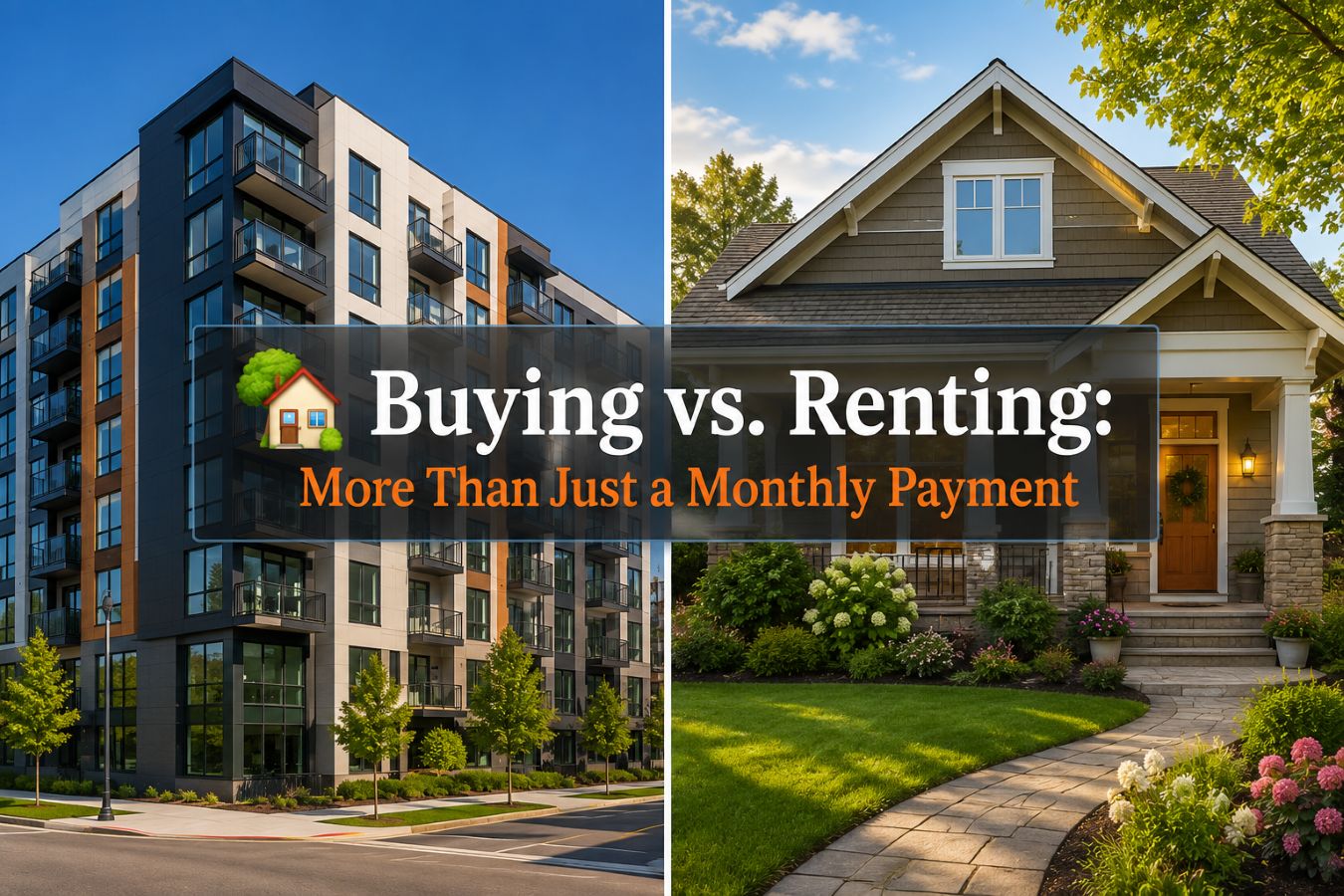
A REALTOR®'s surprisingly honest look at whether you should rent or buy a home in Metro Richmond right now.
Apparently, Richmond renters are winning.
At least that's what one very attention-grabbing housing statistic would have you believe.
According to Realtor.com Economic Research, the estimated monthly cost of renting a starter home in the Richmond metro was $1,527, compared with an estimated $2,378 monthly cost to buy.
That's an $851-a-month difference.
Or roughly...
$10,200 a year.
And now, as the REALTOR® in the room, I'm obviously supposed to explain why this is terrible news and tell every renter to immediately buy a house.
Except...
I'm not going to do that.
Because for some people in Richmond, Chesterfield, Midlothian, Henrico, Glen Allen and the surrounding Metro Richmond area, renting right now may genuinely be the smarter choice.
For others, buying could still make tremendous sense.
The important question isn't:
“Is renting cheaper?”
It's:
“Which choice makes the most sense for ME?”
Let's figure that out.
First, Where Does That $10,000 Number Come From?
This is important, because headlines have a funny way of leaving out the fine print.
Realtor.com's March 2026 Rent Report compared renting with buying a “starter home,” defined for this analysis as a home with 0, 2 bedrooms, across the 50 largest U.S. metropolitan areas.
For Richmond, the report found:
Median rent: $1,527/month
Estimated monthly cost to buy: $2,378
Difference: $851/month
Buying cost approximately 55.7% more per month
That works out to about $10,212 per year in additional monthly housing costs under their assumptions.
You can read the actual methodology here: Realtor.com Economic Research, March 2026 Rent vs. Buy Report
And here's the part that's REALLY important:
That does not mean every Richmond renter saves $10,000 by renting.
Realtor.com's buying calculation assumed:
A 9% down payment
A 30-year fixed-rate mortgage
The median list price for 0, 2 bedroom homes
Property taxes
Homeowners insurance
Average HOA fees
The study also specifically notes that a simple monthly comparison does not capture longer-term benefits and costs such as equity accumulation or the opportunity cost of the money used for closing.
So this is useful data.
But it is not your personal answer.
Why Buying Feels So Expensive Right Now
Two things matter enormously:
Home prices + mortgage rates.
Richmond home prices have remained remarkably resilient.
Realtor.com reported that in July 2026, the Richmond area's median listing price was approximately $450,000, essentially flat from the previous year.
Inventory actually increased 15.2% year over year, which is good news for buyers, but attractive homes were still moving relatively quickly, with a median 40 days on market.
Current mortgage rates are also a big piece of the affordability equation. Freddie Mac reported an average 30-year fixed mortgage rate of 6.67% on August 13, 2026.
Check current mortgage rates directly from Freddie Mac
A buyer's actual interest rate will vary based on the loan, credit profile, points, lender and other factors, but there's no question:
The cost of borrowing money matters. A lot.
So... When Might Renting Actually Be the Better Choice?
Here is where I'm probably going to lose my REALTOR® salesperson-of-the-year trophy.
There are situations where I would absolutely tell someone:
Keep renting for now.
Renting may make more sense if:
You expect to move again in the next couple of years
Buying would wipe out your emergency savings
Your job or location is uncertain
You're working on improving credit
You have significant high-interest debt to address first
The homes you could comfortably afford aren't homes you actually want
Your current rent is unusually favorable
You simply aren't ready for the maintenance and responsibilities of homeownership
Buying a house because somebody told you:
“Rent is throwing money away!”
is not a financial plan.
Neither is buying because you're afraid you'll “miss out.”
Sometimes renting is not wasting money.
Sometimes renting is buying yourself time.
And time can be very valuable if you're using it intentionally.
But Monthly Payment Isn't the Whole Story Either
Here's where the rent-versus-buy comparison gets more interesting.
Let's say renting costs you less each month.
Fair enough.
But what happens to the difference?
If you're saving $800 a month and actually putting that money toward:
A down payment
An emergency fund
Retirement
Paying down debt
Investments
...renting may be helping you build toward something.
Excellent.
If the $800 difference disappears every month into Amazon boxes, DoorDash and a mysteriously impressive collection of things from Target...
well...
that's a slightly different financial strategy.
One of the potential advantages of owning is that part of your mortgage payment generally goes toward reducing your loan balance and building equity over time.
Homeownership can also provide:
More control over your living space
Protection from a landlord deciding to sell
Greater housing stability
Potential appreciation over time
The ability to personalize and improve the property
But ownership also comes with costs renters don't necessarily face directly:
Repairs
Maintenance
Property taxes
Homeowners insurance
HOA or condo fees
Major systems
Appliances
The roof that somehow knows exactly when you've spent all your extra money elsewhere
Neither option is free.
They're simply different financial commitments.
5 Signs Buying in Metro Richmond May Make Sense for You
Buying deserves a serious look if:
1. You're planning to stay awhile
The longer you expect to remain in the home, the more opportunity you generally have to spread transaction costs over time and potentially benefit from equity growth.
2. Your finances are stable
You have reliable income, manageable debt and savings left after purchasing the home.
Please notice I said after.
I do not want someone becoming a homeowner with $14 remaining in their checking account and a prayer.
3. You want housing stability
You're tired of lease renewals, rent changes or wondering whether the owner will eventually sell.
4. You can comfortably afford the payment
Not merely:
“The lender says I qualify.”
I care much more about:
“Does this payment allow me to continue enjoying my life?”
Those are two very different numbers.
5. You found a property that supports your longer-term goals
Maybe it's location.
Maybe it's schools, commute, space, a yard, first-floor living or room for a family.
The house doesn't have to be your forever home.
But there should be a reason you're buying it beyond simply wanting to stop renting.
“But Christine, I Don't Have 20% Down.”
Good.
Because we need to retire this myth.
You do NOT necessarily need 20% down to buy a home.
Loan options vary considerably, and qualified Virginia buyers may also have access to programs designed to reduce upfront costs.
For example, Virginia Housing currently offers home loan and assistance programs for qualified buyers. Its options include a Down Payment Assistance Grant for eligible first-time buyers that does not have to be repaid, as well as other programs that may reduce down-payment or closing-cost requirements. Eligibility requirements apply.
Rather than taking my word for it:
Explore Virginia Housing's official homebuyer loan and grant programs
This doesn't mean everyone qualifies.
And it certainly doesn't mean everyone should buy.
But if the only thing preventing you from exploring homeownership is:
“I don't have 20% saved.”
Let's at least make sure you're solving a real problem, not an old myth.
Richmond Isn't One Housing Market
This is where national calculators, and even metro-wide averages, can become misleading.
Metro Richmond is not one market.
A renter looking at a $300,000 townhome in one area is making a completely different calculation from someone considering a $550,000 detached home somewhere else.
The numbers can change substantially among:
Richmond
Chesterfield
Midlothian
Moseley
North Chesterfield
Henrico
Glen Allen
Hanover
Bon Air
Mechanicsville
Colonial Heights
And the surrounding communities
Property taxes differ.
HOA fees differ.
Home prices differ.
Insurance costs differ.
Available inventory differs.
And sometimes simply expanding the search by a few miles dramatically changes what a buyer can afford.
That's why I don't love answering:
“Is it better to rent or buy in Richmond?”
without asking:
“Where in Richmond? What type of home? How long do you plan to stay? What's your actual budget? And what are you trying to accomplish?”
Now we're having a useful conversation.
What About Waiting for Mortgage Rates to Fall?
This question comes up constantly.
My answer:
Maybe rates come down. Maybe they don't.
I don't believe buyers should make a major financial decision based entirely on predicting where mortgage rates will be six or twelve months from now.
None of us has that crystal ball.
What we can evaluate is:
Today's payment
Today's available homes
Today's financing options
Your savings
Your timeline
Your comfort level
If today's numbers don't work?
Don't force them.
If they do work, and the right home comes along, you may have a reason to move forward.
A future refinance could be possible if rates eventually improve, but I would never recommend buying a home that is unaffordable today based on the assumption that you'll definitely refinance tomorrow.
So Is Renting Really “Throwing Money Away?”
No.
You are paying for housing.
You receive a place to live in exchange.
That's not throwing money away.
But I don't love the opposite argument either:
“Buying is stupid because renting costs less each month.”
Also too simplistic.
Renting and buying accomplish different things.
The better question is:
What does your housing decision need to accomplish over the next 3, 5 or 10 years?
That's where the answer usually starts becoming clearer.
Is it cheaper to rent or buy a home in Richmond, VA in 2026?
On a monthly-cost basis, recent Realtor.com research favored renting. In its March 2026 comparison of starter homes, Richmond's median rent was $1,527 versus an estimated monthly buying cost of $2,378, a difference of $851 per month under the study's assumptions.
Your actual numbers could be very different depending on home price, down payment, mortgage rate, taxes, insurance and HOA costs.
How much money do I need to buy a home in Richmond, Virginia?
There is no single answer. The amount depends on your loan program, down payment, closing costs and other factors. Some qualified Virginia buyers may be eligible for low- or no-down-payment options or assistance programs through Virginia Housing.
Do I need 20% down to buy my first home?
No. Many mortgage programs require substantially less than 20%, subject to borrower and property qualifications.
Should I wait until mortgage rates fall before buying?
Not necessarily. A better approach is determining whether today's payment is comfortable and whether buying supports your longer-term plans. Trying to perfectly time mortgage rates is extremely difficult.
Is buying still a good investment in Richmond, VA?
It can be, but a primary residence isn't just an investment. Your purchase price, length of ownership, financing, maintenance expenses and future market conditions all affect the outcome. Richmond's housing market has remained relatively resilient, but no one can guarantee future appreciation.
What areas around Richmond should first-time homebuyers consider?
That depends heavily on price range, commute, property type and lifestyle. Buyers may explore opportunities throughout Richmond, Chesterfield, Midlothian, Henrico, Glen Allen, Hanover, North Chesterfield and surrounding communities rather than limiting a search to one neighborhood.
Christine's Take: Don't Ask “Rent or Buy?” Until We Run YOUR Numbers
Here's where I land on this.
If you're renting for $1,500 and buying the home you actually want would cost $3,000 a month...
I'm not going to pretend that's the same thing.
And I'm certainly not going to tell you:
“But you'll be building equity!”
and conveniently ignore the extra $1,500 leaving your bank account every month.
That's not helpful.
But I also don't want someone who could comfortably buy, wants to stay in Richmond and would benefit from homeownership to spend another five years renting simply because a headline told them:
“Renters save $10,000.”
Your situation deserves more than a headline.
It deserves math.
Your math.
The Bottom Line
So...
Should you rent or buy a home in Richmond, VA in 2026?
The answer may genuinely be:
Keep renting.
Or it may be:
You're much closer to buying than you realize.
Either answer is okay.
My job isn't to convince you to buy a house.
My job is to help you understand your options well enough to make a confident decision.
If you're renting somewhere around Metro Richmond and wondering whether buying makes financial sense, here's an easy place to start:
Tell me roughly what you're paying in rent, the area you'd like to live in and what you think you'd be comfortable spending each month.
No commitment.
No “Are you ready to buy NOW?” interrogation.
We'll simply figure out which numbers are worth looking at.
Because sometimes the smartest next step in real estate...
is just getting the right information.
Helping You Make Confident Real Estate Decisions
- Christine Case, REALTOR®
- NextHome Advantage
- Serving buyers and sellers throughout Richmond, Chesterfield, Midlothian, Henrico, Glen Allen and Metro Richmond, Virginia
#HumansOverHouses #RichmondVA #MetroRichmondRealEstate #RichmondRealEstate
Talk it through with Christine
Buying in Midlothian, Chesterfield or anywhere in Metro Richmond and want to talk it through first? I'm Christine Case, a REALTOR® with NextHome Advantage, and I would rather help you understand your options than rush you into anything. Start with what living in Midlothian is really like, browse more straight answers on the blog, or send me your question and I'll answer it myself.