2026-09-03 · 10 min read · Metro Richmond
How Do I Know If My House Is Overpriced? 7 Signs Metro Richmond Sellers Should Watch
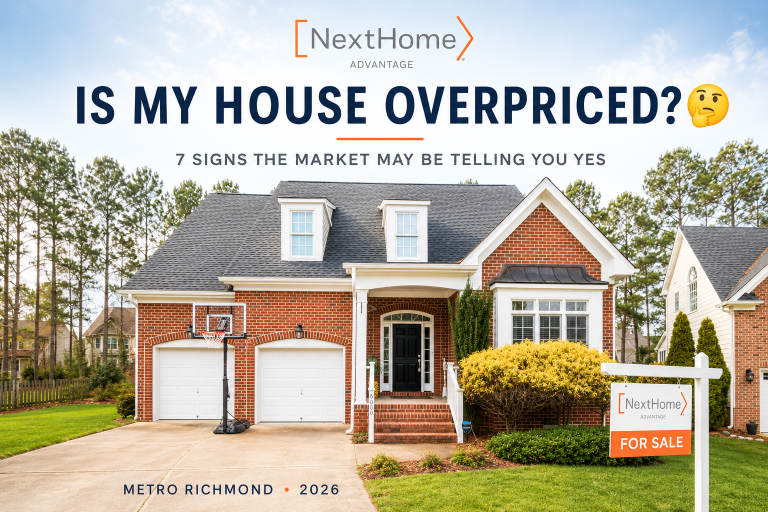
What Showings, Online Activity, Buyer Feedback & Competing Homes May Be Telling You
Metro Richmond Homeowner Resource Center | Seller Guide
By Christine Case, REALTOR® | NextHome Advantage
QUICK ANSWER
How do you know if your house is overpriced?
Usually, the market starts giving you clues.
Your home may be overpriced if you're seeing lots of online views but few showings, showings without offers, repeated buyer feedback about price or condition, or competing homes going under contract while yours sits.
But here's something important:
Overpriced does NOT necessarily mean your house isn't valuable.
It means buyers may currently see better value somewhere else for the same amount of money.
And in today's Metro Richmond market, that's an important distinction.
Virginia had 28,357 active listings at the end of July 2026, 13.4% more than a year earlier. That means many buyers have more homes to compare before deciding where to make an offer.
So how do you know whether price really is the problem?
Here are 7 signs I would watch.
1⃣ You're Getting Online Views, but Very Few Showings
This is one of the first clues.
Today's buyers usually meet your house online before they ever walk through the front door.
They're looking at:
- Your photos
- Your price
- Your location
- Your features
- Your size
- Your condition
- And everything else for sale in the same price range
If plenty of people are seeing the listing online but very few are scheduling appointments, we need to ask:
What's stopping them from taking the next step?
Price may be one reason.
But before automatically reducing it, I also want to examine the photography, presentation, listing information, condition and competition.
Sometimes the price is wrong.
Sometimes the marketing isn't doing the house justice.
And sometimes it's both.
2⃣ You're Getting Showings, but No Offers
This is a different signal.
If buyers are scheduling appointments, your home has already passed the first test:
Something made them interested enough to come see it.
But if buyer after buyer walks through the house and nobody writes an offer, we need to pay attention.
They may like the home...
just not enough at its current price and terms.
Virginia REALTORS®' most recent Confidence Survey found agents reported an average of 1.8 offers in their most recent July transaction, down from 2.3 in June. Only about 23% reported receiving an above-list-price offer. The same survey also noted that some sellers continue to struggle to find buyers willing to meet their listed prices.
That doesn't mean every seller should lower their price.
It means:
Showings without offers are information.
And we need to interpret that information correctly.
3⃣ Comparable Homes Are Going Under Contract, and Yours Isn't
This is one of the signals I'd take very seriously.
Let's say your house has been listed for three weeks.
During that time:
- A similar house nearby lists.
- Buyers tour it.
- It goes under contract.
- Another comparable home lists.
- That one goes under contract too.
Meanwhile...
Your house is still available.
At that point, I don't want to simply say:
“We just haven't found the right buyer yet.”
Maybe.
But we also need to ask:
Why are buyers choosing those homes instead of yours?
The National Association of REALTORS® explains that pricing a home involves much more than looking at one nearby sale. A comparative market analysis can consider comparable homes that have recently sold, are currently under contract and are actively listed, along with your home's size, location, amenities and condition.
Your competition is helping tell us what buyers currently value.
We should listen.
4⃣ Buyers Keep Giving You the Same Feedback
One buyer says:
“The kitchen feels dated.”
Okay.
That's one opinion.
But six buyers say:
“We liked the house, but it feels expensive compared with the other homes we've seen.”
Now we have a pattern.
Buyer feedback isn't perfect.
People are subjective. Sometimes they don't give much feedback at all.
But when the same concern keeps appearing, I pay attention.
Here's where sellers can get frustrated:
“But I can't change the kitchen.”
True.
You may not need to.
Price can sometimes compensate for things you can't, or don't want to, change.
A buyer might love a renovated kitchen at $550,000.
That same buyer might happily renovate the kitchen themselves if another home feels like a better value.
Price and condition don't live in separate little boxes.
Buyers experience them together.
5⃣ A Price Reduction Suddenly Creates Activity
This one's pretty telling.
Your house has been sitting.
Few showings.
Little interest.
Then the price changes...
and suddenly:
- Online activity increases.
- Showings start happening.
- Agents start asking questions.
- Buyers who previously passed take another look.
The house didn't change overnight.
Buyers' perception of its value did.
That doesn't necessarily mean the original price was wildly wrong.
Sometimes a home simply needs to move into a price range where a different group of buyers discovers it.
But if a price adjustment causes an immediate increase in activity, that's useful information about where buyers may perceive the value.
6⃣ New Listings Are Making Your House Look Expensive
Here's something sellers sometimes forget:
Your home's competition changes while you're on the market.
The homes we studied the day you listed aren't frozen in time.
New properties come on.
Others reduce their prices.
Some go under contract.
Others fall out of contract and return to the market.
And buyers keep comparing.
Imagine your home is listed at $525,000.
Then another home nearby comes on the market at a similar price with:
- A renovated kitchen
- A newer roof
- Updated bathrooms
- A better lot
- Or simply stronger presentation
Your house didn't suddenly become a bad house.
But buyers now have another option.
That's why pricing isn't a one-and-done conversation.
We have to keep watching the competition.
Virginia's statewide inventory illustrates why this matters. Active listings were up 13.4% year over year in July, and Virginia REALTORS® says the increase in supply is providing more options for active buyers.
7⃣ Your Home Is Sitting Longer Than Similar Homes
Days on market need context.
I would never tell a seller:
“Your house has been on the market 14 days, so something is wrong.”
That's far too simplistic.
Different neighborhoods, property types and price points behave differently.
Instead, I'd ask:
How long are comparable homes taking to sell?
That's the useful comparison.
And here's why local context matters so much.
Recent Redfin data for Richmond city, not the entire Metro Richmond region, shows homes sold in a median of about 12 days during the three months ending July 2026, and the median sale price was approximately $439,000. Richmond was still classified by Redfin as very competitive.
So I do not want sellers hearing:
“The whole Richmond market is slow.”
It isn't that simple.
A home sitting significantly longer than comparable properties in its particular neighborhood, condition and price range is what deserves investigation.
Christine's Local Insight: “But My Neighbor Sold for More!”
I hear versions of this one all the time.
“The house down the street sold for $600,000. Mine is nicer!”
Maybe it is.
But let's dig deeper.
When did it sell?
What was its condition?
What updates did it have?
What was happening with inventory at the time?
Did it have a better lot?
Different square footage?
A finished basement?
A garage?
Were seller concessions involved?
What other homes were available when that buyer made the offer?
And perhaps most importantly:
What would today's buyer choose between your house and everything else they can purchase right now?
That's why one neighbor's sale doesn't automatically establish your home's current market value.
A good pricing analysis looks at the bigger picture.
“But Can't We Just Start High and Come Down Later?”
Technically?
Sure.
Strategically?
That's where I get cautious.
I completely understand the thinking:
“Let's try the higher price. We can always reduce it.”
But buyers don't experience your listing in reverse.
They see the original price first.
And the early days of a listing can be important because that's when buyers who have already been watching that neighborhood or price range first discover the property.
If those buyers believe the price doesn't match the value, they may move on.
Later, you reduce the price.
Some may return.
Others may not.
And new buyers may wonder:
“Why has this house been sitting?”
That doesn't mean price reductions are bad.
Sometimes they're absolutely the correct strategy.
I simply prefer to make the best pricing decision we can from the beginning rather than intentionally planning to chase the market later.
NAR's consumer pricing guidance specifically notes that current market conditions, comparable sales, property condition, location, amenities and seller goals all factor into an appropriate asking-price strategy.
Does No Offer Automatically Mean My House Is Overpriced?
No.
And this is really important.
A home may struggle to sell because of:
- Poor photography
- Weak online presentation
- Limited showing availability
- Deferred maintenance
- Odors
- Clutter
- Needed repairs
- Difficult layout
- Location
- Lot characteristics
- Competition
- Financing limitations
- Or other property-specific factors
That's why I don't believe the answer to every listing problem is:
“DROP THE PRICE!”
We need to diagnose the problem first.
If nobody is clicking, that's one issue.
If they're clicking but not showing, that's another.
If they're showing but not offering, that's another.
And if you're getting offers, but they're consistently well below asking price, that tells us something else.
The market leaves clues.
Our job is to figure out what they're telling us.
Is Metro Richmond a Buyer's Market in 2026?
Not broadly, no.
This is exactly where I don't want scary headlines replacing actual data.
Virginia had roughly three months of housing supply in July, according to Virginia REALTORS®, even as inventory continued to grow.
And Richmond city itself remained highly competitive in recent Redfin data, with a median sale price around $439,000, roughly 2 offers per home on average, and 45.2% of homes selling above list price in July.
But statewide buyer activity has softened. Virginia REALTORS®' July survey showed its Buyer Activity Index dropping to 38 from 42 in June, and agents reported fewer offers on their most recent transactions.
What does that mean in plain English?
Good homes can still sell very quickly.
Some still receive multiple offers.
But buyers may have more choices, and sellers cannot assume that simply putting a home on the market guarantees buyers will accept whatever price they choose.
And conditions can vary dramatically between Richmond, Chesterfield, Midlothian, Henrico, Glen Allen, and even from one neighborhood or price range to another.
Frequently Asked Questions
How can I tell if my house is priced too high?
Look at the combination of online activity, showing activity, buyer feedback, competing listings, recent comparable sales and how quickly similar homes are going under contract. One clue alone may not mean much. Several pointing in the same direction deserve attention.
If I'm getting showings but no offers, does that mean I'm overpriced?
Not automatically. But repeated showings without offers can indicate that buyers like the home enough to visit but don't perceive sufficient value to make an offer at the current price or terms.
How long should I wait before reducing the price of my house?
There is no universal number of days. The better question is how your listing is performing relative to comparable homes in your specific neighborhood, property type and price range.
And we're going to tackle this exact question in an upcoming Metro Richmond Homeowner Guide.
Does a price reduction make buyers think something is wrong with my house?
Not necessarily. Price adjustments are a normal part of real estate. However, multiple reductions or a long time on market can cause buyers to ask questions, which is why the original pricing strategy matters.
We'll tackle this one separately too, because it deserves more than a two-sentence answer.
Are homes still selling quickly in Richmond?
Some certainly are. Recent Richmond-city data shows a competitive market, but individual results vary substantially based on neighborhood, property type, condition, price point and competition.
THE BOTTOM LINE
If your home isn't selling, I don't want the first reaction to be panic.
And I don't want the first answer to automatically be:
“Lower the price.”
I want to look at the evidence.
Are buyers seeing the listing?
Are they scheduling showings?
What happens after they walk through?
What feedback keeps appearing?
Which competing homes are going under contract?
Has the market changed since we chose the price?
Because your home's price isn't really being judged in isolation.
Buyers are judging its value against every other option available to them.
And that's where the market starts talking.
The market talks. The key is knowing how to listen.
If you're thinking about selling, or your Metro Richmond home is already on the market and you're wondering why it isn't getting the response you expected, I'd be happy to help you look at the numbers and understand what they may be telling you.
No pressure. Just good information and an honest conversation.
- Christine Case, REALTOR®
- NextHome Advantage
- Helping You Make Confident Real Estate Decisions.
Christine Case | NextHome Advantage
Live Resources
These are the sources I'd include at the bottom of the published article:
Virginia REALTORS®, July 2026 Virginia Home Sales Report: Key Takeaways
Virginia REALTORS®, July 2026 REALTOR® Confidence Survey
National Association of REALTORS®, What Goes Into Pricing Your Home
Richmond, VA Housing Market Data, Redfin
Market statistics are snapshots and may change. Richmond-city statistics should not be interpreted as statistics for the entire Metro Richmond region. Real estate conditions vary by location, property type and price range.
Talk it through with Christine
Thinking about selling and want a straight answer on your own house? I'm Christine Case, a REALTOR® with NextHome Advantage, and I would rather help you understand your options than rush you into anything. Start with what living in Midlothian is really like, browse more straight answers on the blog, or send me your question and I'll answer it myself.